
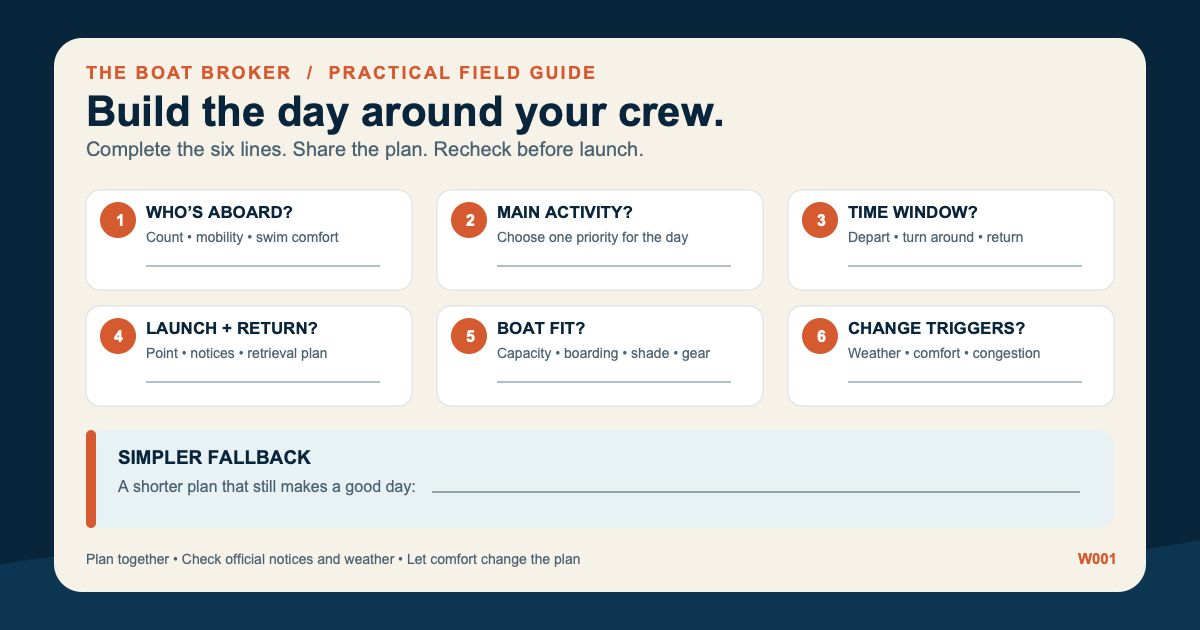
A good Lake Havasu boat day starts with a smaller question than “Where should we go?” Ask what your group wants to do, how much time everyone comfortably has, and what your boat and operator can handle. A short outing with a clear return plan can be a better fit than an ambitious route that leaves somebody tired, uncomfortable or worried.
Use the steps below to choose between a local cruise, a swim-and-picnic outing, a watersports session or a scenic trip toward Topock Gorge. By the end, you will have a one-card day plan to share with your group, use for the final conditions check and bring along when comparing boats.
Start with the people aboard
Before drawing a route, agree on one main activity. “See some scenery and eat lunch” needs a different plan from “spend the day towing riders.” Ask each person about time in the sun, comfort underway, swimming ability, mobility, bathroom needs and the longest stretch they want between breaks. Include the person who is least comfortable on the water.
Write down your expected passenger count and gear. Then check the specific boat’s capacity information and owner’s manual, rather than judging by how many people can squeeze onto the seats. Think through where bags, coolers and activity equipment will go without obstructing movement. If you cannot comfortably accommodate the group and its gear, change the group size or boat before changing the destination.
Choose the kind of day first
|
What the group wants |
A useful starting plan |
What to resolve first |
|---|---|---|
|
First outing or a short family day |
A modest route near the launch, with an early return option |
Boarding, seating, shade and how everyone feels underway |
|
Swimming and a picnic |
One planned stop instead of several destinations |
Whether stopping and swimming are permitted and suitable, plus safe reboarding |
|
Watersports |
A dedicated session in an appropriate permitted area |
Boat suitability, equipment, operator knowledge and the current rules |
|
Scenery and wildlife |
A deliberately planned Topock Gorge outing |
Navigation, fuel planning, refuge restrictions and time to return |
Use the table to choose one primary plan and one simpler fallback. A destination that worked for somebody else, in another boat or under different conditions, still needs a fresh check before it becomes your plan.
Make a one-card day plan
Write this card before packing, then share it with the operator and group:
Group: ____ passengers; comfort, mobility and break needs: ____.
Main activity: ____.
Time available: ____ | Turnaround time: ____.
Launch and return point: ____ | Expected return time: ____.
Boat fit: capacity, boarding, reboarding, shade and storage to confirm: ____.
Change the plan if: ____ | Simpler fallback: ____.
Example: a family with a first-time passenger chooses a short swim-and-picnic outing. They check reboarding access and shade before committing, and agree to shorten the day if anyone is uncomfortable or conditions deteriorate. The operator checks the route, conditions and boat before choosing the launch and turnaround time.
After the trip, note what felt easy, what became frustrating and which boat features would have helped. Use those answers to improve the next outing or compare another boat.
Match the launch to the boat and route
Choose the launch after choosing the outing. The official Lake Havasu State Park boating page distinguishes its Windsor ramps from the north-end personal-watercraft and jet ramp, which does not permit propeller-driven craft. Read the location details before towing to the park; “a ramp at the same park” does not mean the same access.
Check current operating notices, parking arrangements, applicable fees and the return procedure with the launch operator. Consider whether you will be comfortable retrieving the boat after a long day. For an unfamiliar setup, make learning the launch and recovery process part of a shorter outing instead of attaching it to your longest planned cruise.
Treat Topock Gorge as a specific trip
Topock Gorge belongs on a scenic-trip shortlist, but it needs its own planning. The Havasu National Wildlife Refuge rules restrict recreational towing, including tubing, skiing and wakeboarding, within the designated gorge section. Refuge backwaters also have restrictions, including personal-watercraft exclusions and no-wake areas. Follow the current map, signs and buoys rather than a general description of “the river.”
Do not confuse a Topock Marsh launch with a route into the main channel. The refuge’s motorized-boating information explicitly says the marsh launches do not provide Colorado River access. Confirm your actual departure point, intended route and return point. This article is not a navigation chart, and it does not establish clearance, depth or fuel availability along a route.
Let the forecast change the plan
Check weather for the outing area and the whole time you expect to be away, including the return. The National Weather Service’s inland-boating guidance calls for checking the forecast before departure and monitoring developing storms. A pleasant view from the ramp is not a forecast for the afternoon.
Agree in advance that the operator can shorten or cancel the trip. Do not use this article, a boat category or the absence of an advisory as a universal go-ahead. Conditions, the particular vessel, the operator’s experience and the people aboard all matter. Keep an appealing shore-based alternative so changing plans still feels like a good day together.
Make a simple departure plan
Put your launch, intended route, return time and contact details in one place. Use the Coast Guard Auxiliary float-plan resource to give a trusted person ashore useful information, including what to do if you are overdue. Tell that person when you return or when a change of plan is agreed.
Before leaving, work through the boat’s own preparation checklist and confirm appropriate safety equipment, communications, fuel planning, drinking water and sun protection. Review boarding and reboarding with the group. Unresolved questions are a reason to get qualified instruction or local operator guidance before departure, not something to solve after leaving the ramp.
Use the outing to define your next boat
If you are shopping, bring the one-card plan to TBB’s used-boats page. Start with Style / Type and the quick filters that match your use, such as Family Friendly, First Boat, Pontoons or Ski / Wake. Then compare passenger layout, boarding access, shade, storage and the specific boat’s capacity information. A filter narrows the conversation; it does not confirm fit, condition, equipment, price or availability.
When you are ready for a shortlist, send TBB the same card: group size, main activity, typical outing length, must-haves and the tradeoffs you will accept. Ask a broker to confirm which currently available boats are worth comparing. If the category has no suitable match, the brief is still useful for a broker search; do not force the plan around an unrelated listing.
Source information checked October 15, 2026. Recheck official conditions, access and rules before each outing.

