
A desert walk can add a completely different afternoon to a Lake Havasu boat or RV trip. The useful first decision is what kind of outing your group can enjoy and finish comfortably: a shoreline walk, a longer route through washes and rugged terrain, or a shorter plan close to your starting point.
Choose the route, check who manages it, and then check current access and weather. A familiar trail name or an attractive photograph does not answer those questions. This planning guide uses Mohave Sunset Trail and the SARA Park area to show how the details change.
Compare the terrain before comparing the views
Mohave Sunset Trail at Lake Havasu State Park
Arizona State Parks describes Mohave Sunset Trail as 1.75 miles long, passing through lowland desert and along the shoreline. The operator rates it easy and specifies pedestrian use only, with no bicycles and pets allowed on leashes.
That makes it a useful option to investigate for a group seeking a shorter walk. The rating is not an accessibility certification or a promise that today’s conditions suit everyone. Ask park staff about the surface, current restrictions, entry arrangements and the walking distance from your parking place. Check the actual route on the park map instead of assuming the published length equals your complete door-to-door outing.
The SARA Park trail area
The city’s SARA Park page describes the Crack in the Wall outing as a five-mile round trip through a narrow ravine, wash bottoms and rugged hillsides. That is a different commitment from choosing a shorter shoreline walk. Discuss narrow terrain, footing, sustained walking and the return journey with the least experienced person in your group.
Names also matter. The BLM SARA Park map identifies the Yellow Trail as Crack-in-the-Mountain and shows other named trails. Match your intended route to the official map and the trailhead signs; do not combine different descriptions into a made-up loop.
Ask the right manager about access
Lake Havasu State Park, the city recreation facilities at SARA Park, and nearby BLM-managed land are different places to check. The city describes SARA as a county-leased recreation area. BLM’s May 19, 2026 map describes the surrounding trail system, shows land-management boundaries and depicts nonmotorized trails. It does not authorize an OHV outing.
BLM also cautions that a mapped route across State Trust or private land does not create public access rights. Use the land-manager information for the exact route and parking location, not a general assumption that all desert land is open. For BLM route questions, the Lake Havasu Field Office lists 928-505-1200; the city’s SARA Park page lists 928-453-8686 for park questions.
Closure check, October 15, 2026: BLM has announced closures and restrictions on selected Standard Wash OHV Area lands from 11:59 p.m. October 14 through 11:59 p.m. October 17 for Raptor Rally 003. This is a notice for that selected area, not a statement that every Havasu trail is closed or open. Check the notice, posted restrictions and the field office for your specific access plan. Other restrictions can change independently.
Let the day’s conditions set the schedule
Choose a start time and a turnaround time before you leave. Include pauses, the slowest person’s pace and the return to the vehicle. The attractive destination is optional; getting everyone back within the group’s abilities is the plan.
Arizona State Parks’ hiking guidance advises checking weather and trail conditions, carrying more than enough water, dressing for the conditions and staying within your ability. Cooler weather still requires water. Its guidance also says to turn back before using half your water supply. Treat that as one limit alongside heat, fatigue, daylight and changing conditions, not a target you must reach.
Season alone cannot clear a route. Check the forecast and alerts for the location on the day of the walk. For washes and narrow terrain, consider storms beyond the place where you are standing. The National Weather Service explains that runoff from distant thunderstorms can cause flash flooding many miles away. If flooding or thunderstorms threaten the route, change the plan before entering it. Dry ground at the trailhead is not an all-clear.
Write a small trip plan that everyone understands
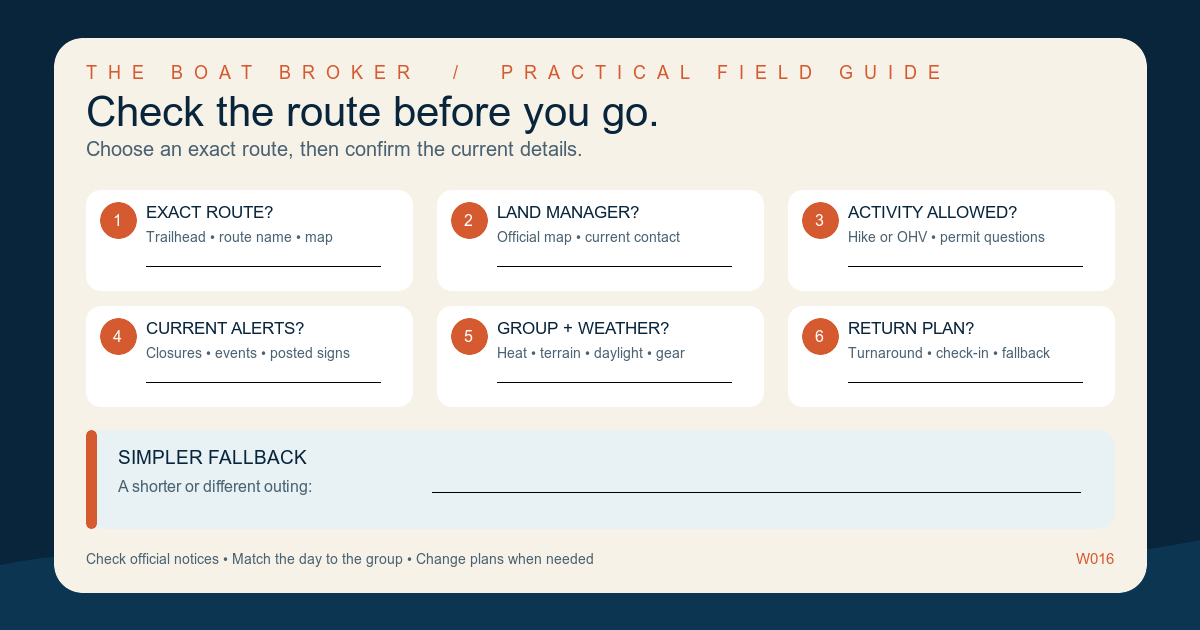
Fill in these six rows with actual answers. Share the route and expected return with someone who is staying behind, and update that person when you return.
| Decision | Record before leaving |
|---|---|
| Route and manager | Exact trail name, official map, responsible agency and current access or closure check. |
| Group fit | Shortest comfortable distance, terrain concerns, mobility needs and pet rules for this route. |
| Weather and timing | Forecast and alerts, start time, turnaround time and the conditions that mean cancel or shorten. |
| Water and equipment | Each person’s water, food, sun protection, suitable footwear, navigation and charged communication device. |
| Vehicle and parking | Confirmed access road, parking location, vehicle limits and enough room to turn around. |
| Return and alternative | Contact who knows the plan, expected return time and a shorter or indoor alternative. |
Save the map for use without a data connection and understand it before leaving. A charged phone is useful, but this guide does not establish cell coverage or a rescue response time. If your group cannot confidently follow the intended route, choose a simpler outing or seek local guidance before starting.
Keep the RV base separate from trailhead access
A booked campsite does not prove that a large RV or trailer can reach and turn around at a trailhead. Confirm road surface, parking restrictions and total vehicle length with the responsible operator. If those details remain uncertain, resolve them before driving there.
Our guide to matching a Havasu RV trip to your rig and family helps with the campsite side. When comparing pre-owned RVs, describe your actual travel routine, passenger needs and where you expect to park. No RV category guarantees trailhead access.
Tell The Boat Broker how you plan to use your RV so a broker can help you compare layouts and specifications for the trips you have in mind.
