
The right RV campground is the one that fits both your equipment and the way your family wants to spend the trip. A lake view cannot make up for a site you cannot comfortably enter, the wrong electrical connection or an itinerary that leaves everyone exhausted.
Start with a short list of needs, then compare the exact sites available for your dates. Around Lake Havasu, even two loops within the same park can offer different hookups. This approach helps you choose a trip before you buy an RV and plan more useful outings with one you already own.
Describe a real day at camp
Imagine arrival, dinner, bedtime and the next morning. Who needs a permanent bed? Will somebody be trying to sleep while others use the table? How much cooking do you expect to do, and where will wet towels, shoes and outdoor gear go? List the things your family needs every day separately from the features that would simply be nice.
Then choose the purpose of this trip: relaxed time at camp, boating, sightseeing or a short practice weekend. One main purpose makes it easier to judge location and amenities. A campground can be a good fit without including every possible activity. Go RVing’s buying guidance likewise recommends starting with sleeping needs, activities and whether you expect utility hookups.
Make a rig information card
Keep the information you need for reservations together. Use the actual RV specifications and measurements, not the model name as a substitute for length. Include height, length, slide-out clearance, electrical service and any separate tow vehicle, towed car or trailer. A campsite’s listed length can describe a different thing from the space needed by your whole combination; ask the operator how its limit is measured.
- Confirm which equipment type the site accepts and where each vehicle will park.
- Check the approach, turning room, back-in or pull-through arrangement and overhead clearance.
- Ask whether slides, an awning and normal access around the RV fit within the site.
- Save the site number, operator confirmation and any special arrival instructions.
For a towable, resolve the specific truck, hitch, trailer and loaded-weight compatibility before booking around the combination. Use the manufacturers’ documentation and qualified help. A campground reservation or an advertised trailer length does not establish that a tow setup is suitable.
Read hookups at the site level
“RV camping” is too broad a description to make a reservation. Confirm electric service, water and sewer separately. Ask where you would fill fresh water or dispose of wastewater if those services are shared, and plan around your actual tanks and expected use. Check your RV’s instructions before connecting; this guide does not prescribe adapters or electrical work.
|
Local example |
What the official page describes |
What to verify before booking |
|---|---|---|
|
Lake Havasu State Park |
Water and 50-amp electric at individual sites; a campground dump station |
Your site’s fit and the waste-disposal plan |
|
Cattail Cove lower campground |
Water and electric, with amperage differing among sites |
The exact electrical service on your selected site |
|
Cattail Cove upper campground |
Full hookups: water, sewer and 50-amp electric |
Your site’s dimensions, access and current amenities |
These details come from the official Lake Havasu campground page and Cattail Cove campground page. They illustrate why you should check the selected site, not assume every loop has the same service. Cattail Cove’s primitive boat-in campsites are a separate experience from its drive-in RV camping.
Use a five-field site fit check
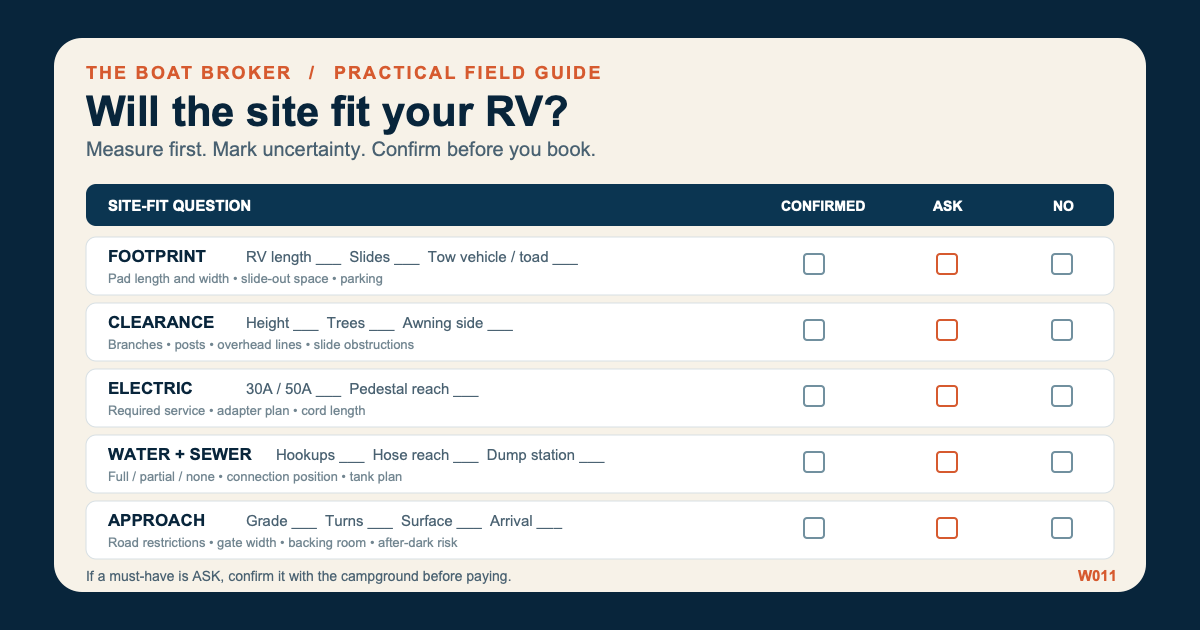
For each candidate site, write down five things: total RV-and-vehicle footprint; slide, awning and access clearance; electrical service; water and sewer arrangement; and parking or approach notes. Mark each field Confirmed, Need to ask or No. Cross out a site with No in a must-have field, and do not let a better view or lower price erase an equipment mismatch.
Site number: ____ | Total footprint: ____ | Slide, awning and access clearance: ____ | Electrical service: ____ | Water/sewer: ____ | Approach and parking: ____.
For each field: Confirmed / Need to ask / No. Operator or source checked: ____ | Date: ____ | Questions before booking: ____.
Worked example (hypothetical): A family planning a longer stay decides that 50-amp service and sewer at the site are must-haves. Lake Havasu State Park passes the 50-amp and water checks, but its shared dump station does not meet their sewer-at-site requirement. Cattail Cove’s lower campground needs an exact-site amperage check and does not list sewer at each site. Cattail Cove’s upper campground passes the utility screen because the official page lists water, sewer and 50-amp service; the family still must confirm the selected site’s dimensions and access before booking. A family taking a short weekend without a sewer-at-site requirement could rank the same choices differently.
Check the family details the amenity icons miss
Trace the trip from the site to the restroom, beach and activities your group will actually use. Ask the operator about the route details that matter to you—distance, steps or grade, lighting, pet limits and shade—and record the answer beside the site number. That makes two attractive sites easier to compare for children, pets or anyone with mobility needs.
Read the current quiet-hour, generator, pet, fire, visitor and vehicle policies. If a particular amenity is central to the trip, confirm it is operating for your dates. Plan meals and an indoor or offsite alternative that still work if the weather changes. Avoid promising the family a campfire, boat launch or activity until the relevant operator information supports it.
Keep the first itinerary manageable
For a first trip in an unfamiliar RV, consider a nearby stay that gives you time to learn setup and pack-down without a long travel day. Go RVing recommends a local shakedown trip once you are comfortable driving the RV. Set an arrival goal that leaves useful daylight, and check the campground’s actual check-in and late-arrival arrangements.
If you are bringing a boat, plan it as a second piece of equipment: storage, trailer parking, launch access and the water outing each need attention. The National Weather Service’s boating guidance is a reminder to check that outing’s forecast and developing storms. Being settled into a campsite does not mean conditions are suitable for going on the water.
Compare the total trip then reserve
Put two or three candidate sites side by side. Note the campsite charge, additional vehicle or reservation charges, fuel, activities and anything you would need to rent or buy. Read minimum stays, cancellation terms and check-out instructions before paying. Use current quotes for your dates rather than a general nightly price from an old article.
For a broader shortlist, TBB’s existing local RV-park comparison links to five operators and explains useful differences. Return to the official booking details to confirm the choice. An article or saved shortlist is not a reservation.
Let the trip shape your RV shortlist
Turn the winning site screen into an RV shopping brief: sleeping spaces that remain usable at night, bathroom and kitchen needs, storage for wet gear, maximum site footprint, required electrical service and how long you expect to go between water or dump stops. Keep that brief beside you while you browse TBB’s current RV category, then verify every promising unit’s actual dimensions, systems and condition.
Share the brief, campground and site number with the TBB team and ask which current listings deserve a closer look. Include the year, make and model of your tow vehicle if a towable is on the list. TBB can help compare the RV candidates; the campground still confirms the reservation and the site’s fit.
Source information checked October 15, 2026. Recheck site amenities, policies, alerts and availability for your travel dates.
