
A waterfront lunch can be the best pause in a Lake Havasu boat day: everyone gets out of the sun, stretches their legs and sits down together. The part to settle before leaving is how your particular boat and every passenger will get from the water to that table.
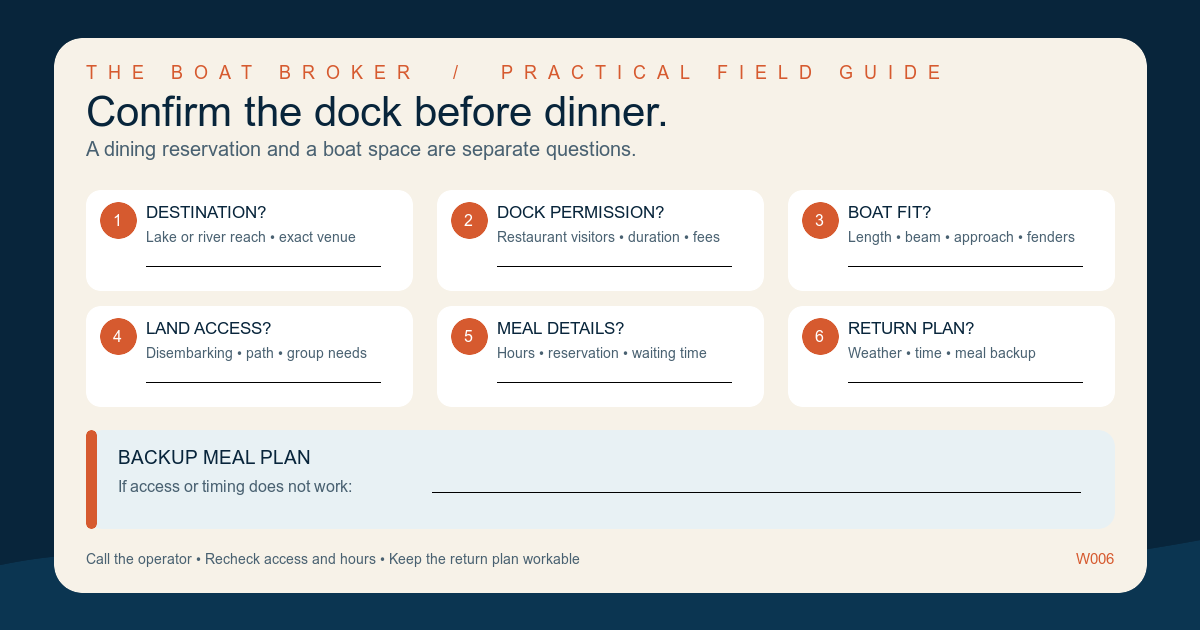
Start with three questions: May we dock there as restaurant customers? Will the available berth and boarding route work for us? Can we comfortably make the return trip? A restaurant reservation answers none of those by itself. Use the two local examples and planning sheet below to make a meal stop that fits your day.
Choose the meal around the people aboard
Tell the group what the stop involves. A person who comfortably boards at your home launch may face a different step, gap or slope at a destination dock. Ask about the complete route from boat to restaurant, including the gangway, walking surface, stairs and restrooms. Describe any mobility needs directly; a photograph of a ramp cannot establish whether a particular boat-to-dock transfer will work.
Also settle the less dramatic details: children who need an early meal, dry clothes, shoes, shade, dietary needs and whether a dog is coming. These choices can change the restaurant or turn a boat-in meal into a drive-in dinner after the boat is put away.
Two Havasu examples with different access questions
The Springs Dining at Havasu Springs
The Springs Dining, at the southern end of Lake Havasu, explicitly advertises courtesy slips for dining customers. Its operator page lists daily restaurant hours of 8 a.m. to 9 p.m. and reservations at 928-667-4593. Those details were checked October 15, 2026; confirm the hours and meal service for your date.
This is a useful starting point because the dining-slip policy is stated directly. It still does not promise an empty berth when you arrive. Give staff your boat’s length, beam and draft, and ask about current availability, any time limits or charges, and the permitted docking location. The restaurant also requires a shirt and shoes. Pack them before departing, rather than assuming swimwear and bare feet will work indoors.
Turtle Grille at The Nautical
Turtle Grille welcomes resort guests and local visitors at 1000 McCulloch Boulevard North. Its dining is indoors with lake views. On October 15, 2026, the page listed 8 a.m. to 9 p.m. Sunday through Thursday and 8 a.m. to 10 p.m. Friday and Saturday. It also states that ordinary pets are not permitted inside; check the policy before planning around a dog.
The resort’s boating page describes docks and guest boat parking. That does not establish restaurant-only visitor docking permission. Before making Turtle Grille a boat-in stop, ask the resort at 928-855-2141 whether day diners may dock, exactly where, and under what conditions. Until those answers are confirmed, treat arrival by boat as unresolved.
The resort also publishes accessibility information about ramps and restaurant seating. Use it to prepare a specific access conversation, including your boat’s boarding arrangement, rather than to assume that every dock-to-table journey is suitable.
Fill out a dock-to-table planning sheet
Copy this table into your trip notes. Write the staff member’s name and the date of the conversation beside the answers. If a detail matters to your group, an unanswered box is a reason to make another call or choose a different plan.
| Question | Write down before departure |
|---|---|
| May we arrive by boat? | Restaurant-only visitor permission, the named dock or berth, and who directs arrivals. |
| Will the boat fit? | Length, beam and draft supplied to the operator; any size restrictions or approach instructions they confirm. |
| What are the docking terms? | Arrival window, availability or reservation method, time limit, charges and any check-in requirement. |
| Can everyone reach the table? | Boat-to-dock transfer, gangway and walking route, stairs, restrooms and passenger-specific needs. |
| Is the meal arranged? | Kitchen hours, party size, table reservation, dietary needs, clothing and pet policy. |
| How do we get home? | Return time, forecast check, fuel plan, launch arrangements and backup meal. |
A useful opening is: “We would like to arrive by boat for lunch on Saturday. We are dining only, with six people, including someone who needs a steady boarding step. Can you confirm which dock we may use and the route into the restaurant?” Add your actual boat dimensions. The numbers in that example are conversation prompts, not a reservation.
Give the return trip as much attention as lunch
Allow for the whole stop: finding the authorized berth, securing the boat, walking, waiting for a table, eating and returning aboard. Choose a departure time from the restaurant before the day starts. A late kitchen closing time does not tell you whether a late boat trip suits your experience, equipment or conditions.
The National Weather Service’s inland boating guidance calls for checking the forecast before departure and monitoring changing weather. Reassess before leaving the dock and again before heading back. Do not let a table reservation pressure you into continuing when conditions no longer suit the boat or group.
Carry drinking water and a simple backup meal. If the permitted dock is full, do not improvise a berth on private property or assume beaching is allowed. Ask the operator about an approved alternative; otherwise use your backup plan. A road visit on another day can be the better way to enjoy the same restaurant.
Use the outing to sharpen your boat requirements
For the broader trip, our Lake Havasu boat-day planning guide helps you match activities to the group. If you are shopping, use this meal plan while comparing used boats: look at boarding gates, handholds, seating, shade and storage for lines and fenders. Confirm each boat’s specifications and inspect the layout; a category name does not establish dock access.
Tell The Boat Broker how you want to spend your boat day, including your usual group and boarding needs. That gives a broker a practical starting point for helping you compare suitable boats.
